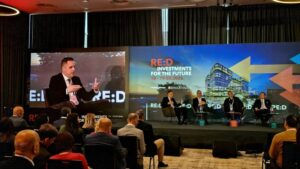
Real estate in Croatia is already unaffordable for domestic citizens. It was precisely for this reason that the Filipović Conference was held, in which Predrag Tutić, Country Manager at CBS International, part of the Cushman & Wakefield Group, also took part.Below we present everything about the state of real estate in Croatia as reported by the portalDom i Dizajn.The Filipović Conference on real estate development and market trends in Croatia, held at the Esplanade Hotel in Zagreb, judging by what the speakers said, passed with somewhat less optimism than previous ones. This, of course, is no surprise given the well-known circumstances such as inflation, the war in Ukraine, the post-pandemic period, the lack of qualified labour in construction and so on. Development and market trends in real estate over the five-year period from 2023 to 2027 were presented, all of which were more or less viewed with a dose of caution. One could conclude that the current situation for investors is such that investments should not be abandoned, but it is good to take many factors into account before final decisions.
Inflation rate and real estate in Croatia
At the round table on the economy in the service of real estate development and the market, various general forecasts could be heard, from optimistic ones that Croatia will get through all of this relatively well to those that the situation will be more difficult and will not recover for several more years. – Demand will normalise in 2024, the shocks should be behind us by then, even a reduction in lending rates, said Hrvoje Stojić, a macroeconomist from PBZ Croatia osiguranje for the management of mandatory pension funds. He did not want to give advice to investors because of the interest rate shock, as interest rates are rising much faster and earlier than was expected a year ago. Regarding the crisis, since Ukraine still had quite a few reserves when it entered the war, primarily related to agriculture in which they were quite important for the wider market, what the situation will be like without those reserves will only be seen next year. – A lower inflation rate is expected next year, and in a few years the situation will return to normal in Europe, said Goran Šaravanja, an economist from the Croatian Chamber of Economy, who believes that the risks for Croatia are much lower for a number of reasons. Hrvoje Stojić also highlighted another potential global risk – the behaviour of the Chinese economy and the fact that the recession would be even greater if it were not for the lockdown there, but they will eventually come out of the lockdown and act inflationarily on the world economy, which should not be ignored. Goran Šaravanja said, however, that entering the Schengen zone and introducing the euro will be positive for the real estate market, in which he sees prospects for Gorski Kotar, Lika and Istria, which is sparsely populated, because interest will be greater. When asked whether real estate will become unaffordable for Croatian citizens, Hrvoje Stojić replied that it already is, that this trend is already the case. There are quite a few smaller buildings on the market for those with greater purchasing power. – I think that residential real estate prices will slowly begin to stagnate, although Zagreb is a specific market due to the consequences of the earthquake and lower supply than, say, in 2019, and there is demand for quality residential real estate, pointed out Marin Štenglin, a Management Board member of the Alfa Stan Group.
Residential real estate prices could begin to stagnate, although Zagreb is specific due to the earthquake and lower supply
At the round table The Pentathlon of Real Estate Market Development – housing, tourism, offices, retail and logistics, Dubravko Ranilović, partner at the agency Kastel – Zagreb and president of the Real Estate Business Association at the Croatian Chamber of Economy, spoke. – Demand from foreign nationals is high, almost 40 percent of real estate was acquired by foreigners this year. However, Germany, where many of them come from, has recorded a slowdown in the real estate market over the last three months, which could spread to us as well, he said. He added that the asking prices of real estate are already often unrealistic, but for this to truly be reflected in prices, more time needs to pass; thus, in the last crisis, sellers tried to offer real estate at previous prices for six months before the first major corrections occurred in the market. Ranilović criticised the excessive apartmentisation on the coast, encouraged by the very low flat-rate tax, which no longer encourages the domestic population but attracts foreign investors.
Predrag Tutić from Cushman & Wakefield/CBS International and Patrick Franolić from the agency Spiller Farmer reflected on the office market in Croatia
Predrag Tutić, Country Manager from Cushman & Wakefield/CBS International, reflected on the office market, saying that there are few such projects and that the realisation of two larger buildings in Zagreb is announced. The reason for this is that office rent is relatively low although very stable, and the investments in such projects are large. Working from home in Croatia has not reduced demand for offices, said Patrick Franolić, Managing Director of the agency Spiller Farmer, because it is mostly present in industries that are in their own buildings.
Real Estate in Croatia: Retail Sector
Some of them sold their office buildings and immediately found buyers because there is demand for renting and buying. Many office buildings here are more than 15 years old, which is not good. Predrag Tutić also said that there is a need for offices in Split and Rijeka, but that investors need to study carefully which type of such buildings to construct.
Construction: Material prices are falling, but there is no labour force
Marin Štenglin, a Management Board member of the Alfa Stan Group, spoke about the projects of the company Alfa stan, as well as about investment opportunities and the labour force in construction. – We constantly listen to the market and the economy and have to put all of that into a realistic projection, see it through to the end and listen to our inner feeling. In our Keglić project in Zagreb, an old building that benefited neither the city nor the population was demolished; we decided to open up the entire block, with new buildings connecting the neighbouring streets. It will be of mixed business-residential use, with three levels of parking; there is enormous interest among the residents of that part of the city in parking spaces, and it will be built over the next three years, said M. Štenglin. Commenting on construction material prices, he said that iron, for example, is even cheaper than in 2019, as are some other materials whose prices have fallen. – However, we have a major disruption in labour prices; everyone in the chain is patching up the shortage of labour. We currently have workers from Ukraine, Nepal, and even two Mexicans on the construction site, after they earned the right to a pension working abroad, because the wages themselves do not differ much from those in Zagreb. – Due to the slowdown in cooperation with the City of Zagreb, two years ago we opened locations in Split, taking on the role of developer for, for example, a quality home for the elderly. Abroad, such top-quality facilities are like hotels; those who stay there have their own garden, a trainer, food of their choice… The price of accommodation is around 3,000 euros a month. That sounds like a lot to our people, but, say, an acquaintance of mine who was a caretaker at a school in Switzerland has a pension of 6,000 euros, M. Štenglin cited one of their current investments, and they are also considering a hotel and a sports-recreational project. – Regarding shopping centres and retail, we have plenty of everything. Only retail space is lacking in some neighbourhoods in Zagreb, say in Sesvete. The future of cities is in brownfield investments, that is coming, such as the renovation of, say, Koteks in Split; there is no need for greenfield, believes Franolić. Regarding logistics, current capacities are also more or less sufficient, the participants concluded, just enough with those that have now been completed, although there are still a few projects announced.